
“We won the minute they started doing pole dancing for exercise.” Ryan Gosling as Jacob in Crazy, Stupid, Love on the battle of the sexes.
When I was in college, Naomi Wolf’s The Beauty Myth was the mainstream feminist text of the day. It posited that as women gained more power in the world, so did the pressure to adhere to unrealistic social standards of physical beauty and because of commercial influences on the mass media women were more objectified than ever. Personally, these ideas gave me pause to evaluate my own self-image and consider the role the media had played in shaping my standards of beauty.
Flash forward 25 years and not only are women’s bodies still being used to sell everything from deodorant to cars, we now have access to more images than ever before through social media. Each of us is curating a story about what we want the world to know about us; pics of our dogs, our lattes, selfies. There used to be great debate about the dangers of television but we have so evolved beyond that, that television seems benign compared to the image-based world we are living in today. It is impossible to avoid being constantly bombarded by images, day in and day out. No matter where you are, there is a television, an advertisement, a magazine, a logo, computer screen or phone in your hand to deliver ideas and standards of beauty.
Of course we all want to be pretty and admired. However, one scroll through my Instagram feed is enough to make me cringe. Smart women with feeds showcasing their bodies in hyper-sexualized ways that would be worthy of old-school Playboy. Then there is the argument that it is our choice. The idea that we have achieved such freedom and equality that women have the choice to do what they want with their bodies. I get it but I am baffled.
It seems to me that we have turned self-objectification into empowerment and it does not seem to be in an ironic way. I recently had a frustrating conversation with a man who told me that he thought women wanted men to look at them with lust- he even went so far as to suggest that women who worked in the sex industry were seeking male attention. I tried to make an argument that our society has turned women’s sexuality into a commodity and that for many women it becomes the only currency they have, especially when they have not had access to education and opportunity.
However, what about the educated women? Women who are talking about their boob photos and perfect moist pouty lip selfie as empowerment? Maybe it is empowerment- if they believe it. Or maybe the brainwashing has gone so far that we are our own worst enemies.





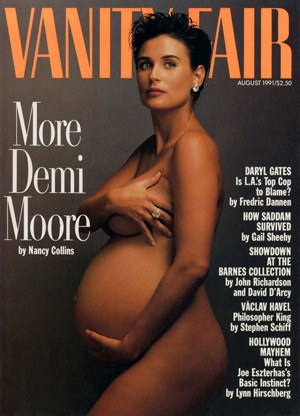 The Ron Mueck sculpture ‘mother and child’ depicts the most basic of human experiences; the moment of birth. If you’re reading this- you’ve been there! How can something depicting this universal and authentic experience be censored? It’s been over 25 years since Demi Moore bravely graced the cover of Vanity Fair magazine when she was seven months pregnant. It was a bold move for a Hollywood star considering they weren’t even allowed to use the word ‘pregnant’ in ‘I Love Lucy’ in the 1950s.
 Carmen Thyssen, a baroness through her marriage to her third husband Heinrich and Miss Spain in 1961, started collecting art in the 1980s using her husband’s fortune. She amassed a collection that includes Monet, Braque, Hassam, Rubens, Degas and many more. There has been a lot of social scandal concerning her collection since her husband’s death that make her life sound like a telenovela. In the museum, the walls are all salmon pink, it is SO bold and one of the requirements made by Carmen. In 2011, she also opened a museum in Malaga that focuses primarily on 19th century Spanish art.
 The nameless woman in The Hotel Room by Edward Hopper is a wonderful piece for a solo female traveler to contemplate. Here is what the museum has to say about this extraordinary work:
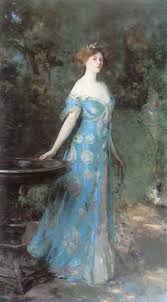 Duchess Millicent Sutherland painted by John Singer Sargent in 1904 was much more than a pretty face. A fierce advocate for social reform and better working conditions despite her social status, she was sometimes called ‘meddlesome Millie’. During WW1 she organized an ambulance unit and was recognized by the Belgium, French and British Red Cross for her work during the war. She was married three times and penned several novels. The 1926 review of her novel ‘That Fool of a Woman’ in The Saturday Review stated: The power of the book lies in an emotional but extremely intelligent style, in an analysis of character which is revealed as much by detail as by words, in a feeling for atmosphere (war-charged Europe is particularly real), but mostly in the fact that the heroine is a sentimental heroine with a brain. Never does she see her mistakes quite in time—but neither is she hopelessly stupid nor a wilful misrepresenter of unflattering fact. Lonely, lovely, sentimental creature that she is, very much too late she sees the wherefore and why of foolish choice and subsequent disaster.
 Jane Bauer