Food, Living

It takes a village… the building of our Chiles&Chocolate Cooking School

picmonkey-collageI have been involved in several building projects while living in Mexico but none has been as exciting or as rewarding for me as our Chiles&Chocolate Cooking School. Located in the village of Zimatan, I wanted the building to fit in with the architecture of the buildings in this rural area. Most of the houses in the village are rectangular with small windows and galvanized metal roofing. Since our cooking classes showcase the beauty and dignity of Oaxacan cooking, our building needed to be a testament to that as well. In the same way a mole recipe evolves using the ingredients of a particular area, our building needed to use materials that were found around us; river rock, stone, wood and I felt the same should be applied to labor.

Village life is very gender segregated. Women in my village are not even permitted to attend town meetings unless they are the ‘head of their household’- meaning they have no husband. So I was more than a little nervous as this project was my first time building without a husband to negotiate and deal with decisions such as where to put the septic tank.

Blandino, the mason, and his two sons, who live in the village, collected rock from around the property to build our retaining wall and patio. In other projects I have been involved with we always ordered our cement blocks already made from the hardware store. Blandino mentioned that Andres, a man in our village, made blocks, so we decided to make them on-site. This decision led to us having a higher quality block, it was about the same price as buying the ready-made blocks, but we also created a job.

Seeing Andres make blocks was amazing. All cement was mixed by hand, poured into molds and then set in the sun to dry. When it came time to get a door, the metal smith in the village made one and the electrician who installed the lights lives just a few doors down.

In the cooking classes I talk a lot about the dignity of what we term ‘women’s work’- cooking, housekeeping, child rearing. My experience of being a stay-at-home mother in Mexico during my daughter’s early years was life changing and forced me to reevaluate my own ideas about gender. It was the beauty of this time that led me to want to give cooking classes.

I always have thought of the cooking classes as a way of shedding light on the dignity of ‘women’s work’ but as I look around the cooking school it dawns on me that the building is truly a testament to the beauty of ‘men’s work’.  Much in the same way it takes a village to make a tortilla; men to grow the corn and women to grind, form and cook it on the comal, our cooking school is the product of a long line of tradition.

For more information about our classes: www.HuatulcoCookingClasses.com

Food

Porcini Sea Salt

porcini-saltOur latest salt is made with wild porcinis from San Antonio Cuajimoloyas, a village 56 kilometers away from the Oaxaca city. Located 3200 meters above sea level, the high-altitude is the ideal climate for mushroom foraging in the rainy season.  I had the privilege of attending the annual Mushroom Festival in Cuajimoloyas last July and in addition to porcinis we collected over 200 different types of fungi during our 6-hour hike.
The name porcini means “piglets” in Italian. They’re also known as the king bolete, cèpe (in French), Steinpilz (the “stone mushroom” in German), and a host of other fun names from all over the world. The Latin name is Boletus edulis.

Porcini mushrooms are a famous and delicious addition to any dish. Forage the ultimate umami flavor with our Wild Porcini Sea Salt. Hearty porcini mushrooms are mixed with natural sea salt to produce a mouthwatering, savory blend that shines in any cuisine. Like so many other good edible mushrooms, porcini are mycorrhizal. This means that the underground vegetative growth of the mushroom, called the mycelia, enters into a symbiotic relationship with the roots of plants. Why would you care as a chef? It means that because of this complex relationship that occurs in nature, porcinis aren’t easily cultivated and are seasonal.

Sprinkle Wild Porcini Sea Salt on beef, veal, pork, poultry, fish, rice, potatoes, pasta, polenta, popcorn, soup, cream sauces, tomatoes, dipping oil, rubs.

Other sea salts in our line are Rosemary Sea Salt and Hibiscus Sea Salt. They are available at our restaurant Café Juanita in Marina Chahue, Huatulco and at our cooking school, Chiles&Chocolate. http://www.huatulcocookingclasses.com


Food

Save the Fish Taco

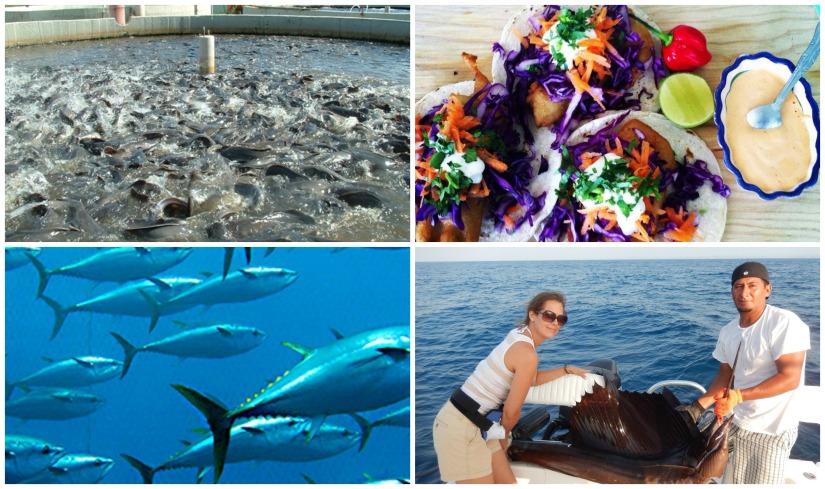
4073ADD6-FACA-4F2E-9FD8-74F984CE9B25.jpgLiving by the ocean, it is amazing to me that when I go to the corporate-owned supermarket the only seafood available is imported and most likely farmed. To get local fresh fish one needs to go find the guys with coolers on the street corner or small fish stalls.

While for most of us fish is an occasional meal, chicken, beef and pork being the most common protein in the North American diet, for much of the world fish is a main staple.

About 1 billion people largely in developing countries rely on fish as their primary animal protein source. In 2010, fish provided more than 2.9 billion people with almost 20% of their intake of animal protein, and 4.3 billion people with about 15 % of such protein.

At Café Juanita and Frida’s Fish Taco Food Truck, we are committed to only serving locally caught fish. This means occasionally not having fish or at times ‘making do’ with fish that are less popular.

When I first moved to Southern Mexico almost 20 years ago the waters were abundant with marine life. My then-husband routinely went diving for lobster, came home with fresh yellow fin tuna or amberjack.

In the past few years I have noticed a large decline in the amount and variety of fish available. Part of this is due to warmer waters and less cold currents that my favorite fish favor. Causes of this are global warming, overfishing by large-scale fisheries, pollution and contamination.

A few things you can do to protect the ocean and guarantee delicious fish tacos will still be available in 20 years!

  1. Eat sustainable seafood.

Global fisheries are on the verge of collapse. According to the U.N. Food and Agriculture Organization (FAO), three quarters of the world’s fisheries are now overexploited, fully exploited, significantly depleted or recovering from overexploitation. Ask your seafood restaurant or fish market to buy from sustainable fisheries. Look for special terms like “line caught”, “diver caught”, “sustainably caught” or “sustainably harvested.”

  1. Reduce energy use.

Carbon dioxide from burning fossil fuels is making our oceans more acidic. One consequence could be the loss of corals on a global scale, as their calcium skeletons are weakened by the increasing acidity of the water. There are many simple ways you can reduce your energy use. Ride a bike, walk or use public transportation. Use high efficiency appliances in your home. Turn off appliances when they aren’t in use. Turn up your thermostat a few degrees in the summer and down a few degrees in the winter. Use compact fluorescent light bulbs in your house.

  1. Use reusable plastic products.

Plastic debris in the ocean degrades marine habitats and contributes to the deaths of many marine animals. Because floating plastic often resembles food to many marine birds, sea turtles and marine mammals, they can choke or starve because their digestive systems get blocked when they eat it. Help prevent these unnecessary deaths—use cloth grocery bags and reusable water bottles.

  1. Properly dispose of hazardous materials.

Motor oil and other hazardous materials often end up washing into coastal areas because they aren’t disposed of properly.  This pollutes the water and hurts the overall health of our oceans. Be sure to dispose of hazardous waste in an environmentally safe way.

  1. Use less fertilizer.

When fertilizers are used in gardening and agriculture, the excess eventually ends up in the ocean. One result is a “dead zone” — an area with very low levels of oxygen in the water — the size of New Jersey in the Gulf of Mexico during the spring and summer. Since all marine life requires oxygen to live, including fish and shrimp, they must flee the area or die. Many other coastal areas are at risk too. So, use fertilizer sparingly and remember more is usually not better.

  1. Pick up garbage and litter near beaches.

Much of the plastic and debris found in the ocean has its beginnings in beach litter. As beach crowds increase, so does the amount of trash left behind. Don’t let your day at the beach contribute to the destruction of our oceans. Bring a trash bag with you for your garbage and volunteer for beach clean-ups.

  1. Buy ocean-friendly products.

Avoid products produced through unsustainable or environmentally harmful methods. For example, avoid cosmetics containing shark squalene and jewelry made of coral or sea turtle shell. These products are directly linked to unsustainable fishing methods and the destruction of entire ecosystems.


Food

The Perfect Bite

I am a dainty eater. Maybe discriminating is a better word. I don’t like to feel full, definitely not stuffed. I like to stop eating at the point where I feel sated but I might have a little more room in case something else is around the corner. Going to a restaurant with me can be annoying, occasionally I declare myself done after consuming only a third of what’s on the plate. I am specific about what I want….. no buffets, no overstuffed American-style plates that could feed a small village, no coffee in glass cups, toast must be buttered when it is hot- is there anything more depressing than unbuttered toast with a little-frozen package of butter on the plate?

I don’t mind eating alone in restaurants. Books are always a good prop, I like the freedom to eat slowly and focus on the food. Especially if I am eating something so exquisite that it will make its way into my food memory hall of fame. Memories I pull out with relish and such detail that I can almost recreate the taste in my mind. So, despite being a dainty eater, I love food.  It’s that I am in such awe of those perfect bites; a moment on your tongue, swallowed and then gone- that’s why it’s important to pay attention.

People are always asking what I miss from Canada. Nothing really I say… but croissants. I didn’t even know how spoiled I was growing up in such an abundance of buttery lightness. My father would slip me a five dollar bill on Sunday mornings and send me to the family-run grocery store next door and I would come home with a half dozen croissants. This was our pre-breakfast… later would come brunch. The croissants were light and flaky, staining the brown paper bags they were served in and leaving crumbs between the plate and your mouth. These croissants didn’t need anything added; no jam or knives necessary- you pulled them apart with your fingers, the warm dough stretching and crumbling. Eating them was like not having a care in the world.

When my daughter was little and we spent summers in Montreal, we would stop by the bakery after day camp; an almond croissant for her and a plain one for me. We were such frequent customers that the counter girl visited us in Mexico a couple of years later.

Recently, a friend of mine was driving me through the streets of Oaxaca on our way to breakfast when, over the smell of exhaust and city fumes, I caught the beckoning odor of butter and baking. I turned and saw something fleeting out of the corner of my eye- a small doorway. I hesitated for a moment, like when you see someone you might know but haven’t seen for a while and you are not sure if you should say hi.

“Do you mind driving around the corner? Was that a bakery?” I said.

My friend drove around the block and double parked outside the small door.

“I’ll just be a moment,” I said.

Yes, the smell of baking and butter hugged me. Baguettes lined the walls like old friends. Not supermarket–style baguettes- these were long and thin like elegant Frenchwomen’s arms. Pastries sat in baskets in a glass case. One solitary croissant smiled up at me and whispered ‘bonjour.’ I ordered fast, randomly pointing to a focaccia, almond croissants, and a sourdough. All packaged up in brown paper bags.

Back in the car I pulled out the bag with the lone plain croissant and ripped off a piece for my friend.

“Here, try this!” I said stuffing a piece into his mouth as he drove, then I ripped off a piece for myself, leaving flaky buttery crumbs all over the seat. The texture of the croissant was perfect and when I put it in my mouth I thought… Am I going to have to share the rest of this? I did… but I didn’t want to.

Boulenc Bakery, Porfirio Diaz 222A, Oaxaca, Oaxaca, 01 951 514 0582 

Open 8am- 8:30pm


Living

Supporting Girls’ Education

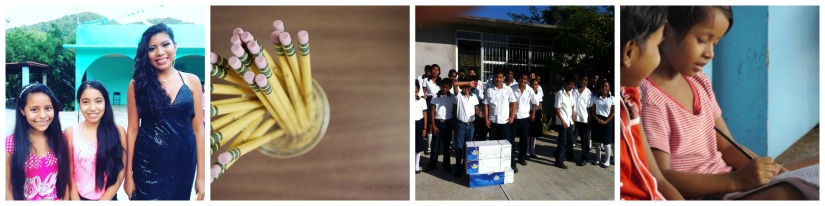
PicMonkey CollageFifteen is a magical age- in Mexico it is the time of quinceañeras and celebration as girls teeter on the brink of womanhood. It is also the age of high teen pregnancy rates- especially in lower income areas. The report — “Maternity childhood” Population Fund United Nations (UNFPA) revealed that Mexico is the leading nation in teen pregnancies with the alarming rate of 64.2 teen pregnancies per thousand births. Generally speaking, teen pregnancies are associated with poorer living conditions and the girls receiving lower levels of education. Girls with a higher education level, with a dream for the future and with a hope of success are much less likely to get pregnant.
A few years ago I met Johanne Lalonde in one of my cooking classes. In my classes I talk a great deal about the magic of the tiny village where I live- just 25 minutes from a world-class resort area but a world away- with no telephones, internet and many households still cooking on open fire, growing their own corn and maintaining an incredible amount of self-sufficient living. The village has a kindergarten, an elementary school and a secondary school (grades 7, 8 and 9)- making it possible for children to be educated within the village until that magical age of 15.
I started to notice that while some girls continued studying to high school even though their families now had to cover transportation costs to attend the high school in a neighboring village- many did not. Many got pregnant.
While some studies point to the lack of contraceptive education or acceptance with regards to teen pregnancy. I firmly believe that education, visualization and hope of a future are much bigger factors. Young women and girls need to proactively choose their future.
From this idea, Johanne and I started a program we named ‘Sigue Estudiando’ (Keep Studying) with the goal of keeping girls in school. One girl from each grade in secondary school would receive a scholarship towards her future educational needs.
Unicef reports in their study on gender equality ‘Providing girls with an education helps break the cycle of poverty: educated women are less likely to marry early and against their will; less likely to die in childbirth; more likely to have healthy babies; and are more likely to send their children to school. When all children have access to a quality education rooted in human rights and gender equality, it creates a ripple effect of opportunity that influences generations to come.’
When we support girl’s education we are supporting not only the individuals but helping communities to break the cycle of poverty. We are in the second year of the program currently have 6 scholarship recipients and while it is early to track the success of such a program, I have no doubt that it is having a positive effect. I asked last year’s recipients to write a letter to Johanne and I was very moved when one of the young women succinctly wrote that the biggest gift, more so than the money, was the knowledge and encouragement that came from knowing someone was caring for their education.
If you are interested in helping or getting involved please contact me through The Eye.
theeyehuatulco@gmail.com
Currently I am trying to get laptops for this years recipients- if you would like to donate one or have a gently used one that you don’t use, please let me know.
Food

Deep Fried Boletus’

I just had the pleasure of attending the Cuayimoloyas Mushroom Festival located 3200 meters above sea level and an hour away from the city of Oaxaca. The festival included a guided 5 hour foraging walk through the lush Grimms’-fairytale – like forest, a night in a cozy cabin and incredible local food. The festival attracts mostly naturalists, biologists, birders and of course mycologists.

The highlight for me was the cooking class led by Martha Contreras. One of the dishes she showed up was deep fried Boletus’- all done on an anafre of course!

1. In a mortar and pestle smoosh 10 small garlic cloves and a handful of fresh oregano until they form a paste. Add 1/2 teaspoon ground black pepper and blend.


2. Slice Boletus’ into 3/4 inch pieces.

3. Add 1/3 cup of water to garlic paste mixture, 3 eggs and 1/2 cup of bread crumbs.

4. Soak pieces of Boletus in mixture for 10 minutes.

5. Fry in 1/4 of very hot oil until browned.

6. Serve with fresh tortillas.

Food

The Art of the Tortilla

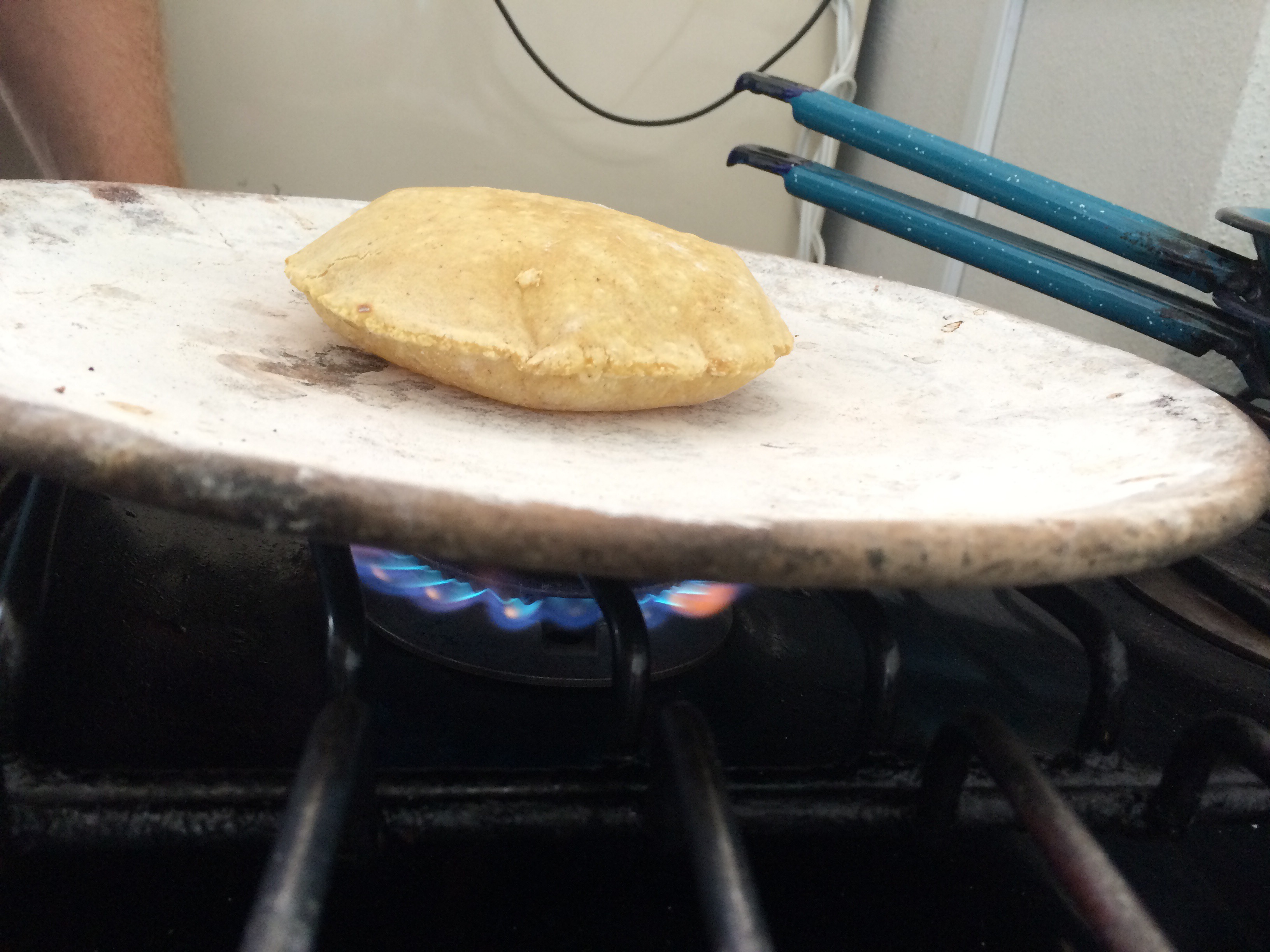
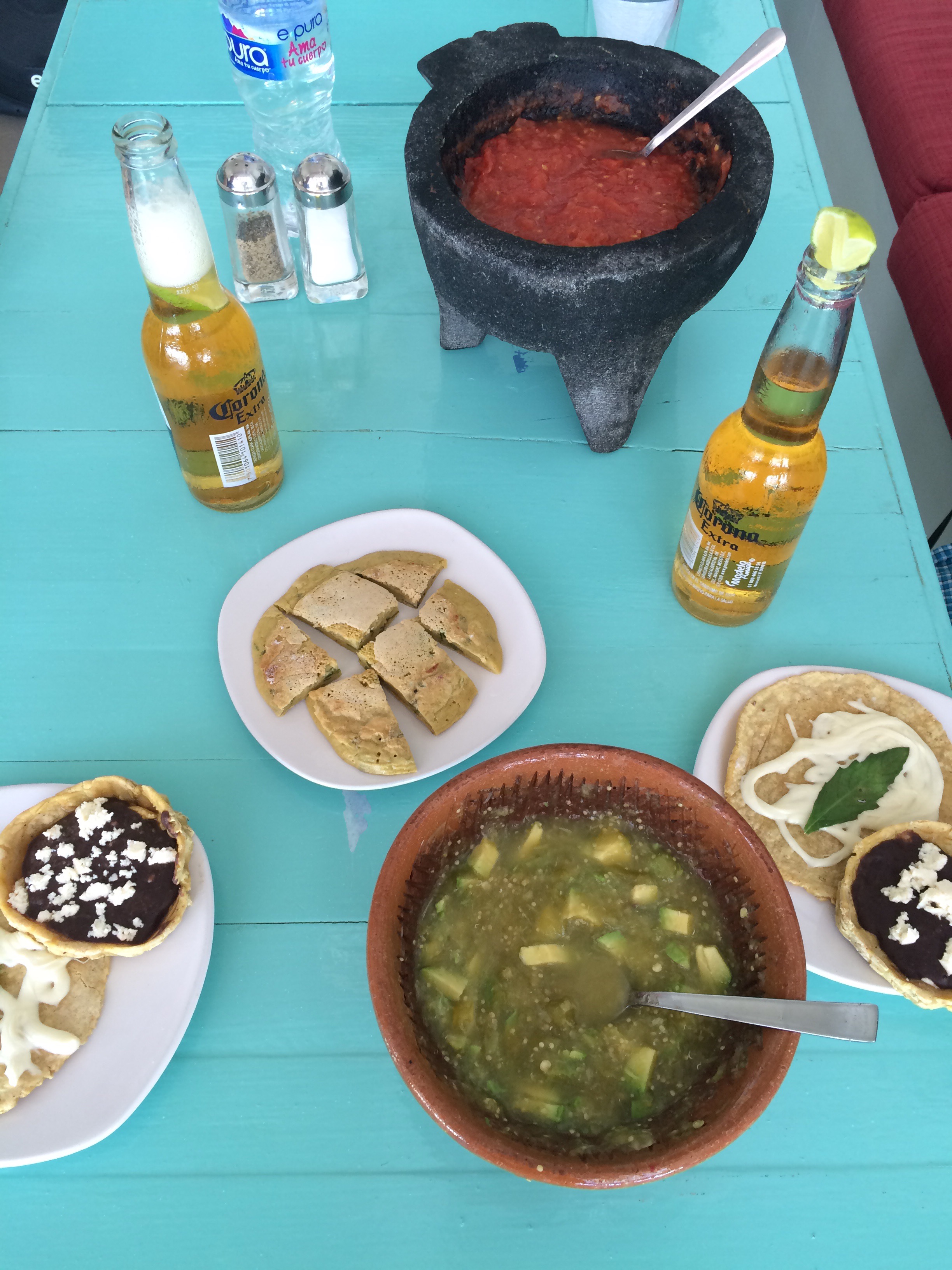
Corn is the most important food in the state of Oaxaca, Mexico. The base of the Sierra Madres is populated with small rural villages where most households grow their own corn rations for the year. This corn, a diet staple, will be used for everyday tortillas and sopes as well as a thickener for special occasion moles (sauces) that the cuisine of Oaxaca is famous for. In our Street Food class this week we made tortillas on a traditional comal, paired it with spicy salsa from our mortar and pestle and Oaxacan string cheese (quesillo) and washed it down with our hibiscus margaritas!! There is no better way to get to know a culture than through its food. For more information about our cooking classes:

http://www.huatulco-catering.com chiles.chocolate@yahoo.com